Showing posts with label tips. Show all posts

Tuesday, 12 March 2019

Found - a submissions recording system that works for me


My first submissions book - so neat!
For a long time I have been trying to find a way of recording my submissions that works for me. Everyone swears by Excel, but its not for me. I think it's that link to maths (formulas) and boxes that does it. Besides sometimes I don't want to have to switch my laptop on every time I want to check something.

I chatted to a few people online about it. One person uses a Table in Word. Mmm, a possibility, but I remember when I was in one particular job when I worked with a Table and all was fine until I had to inset new stuff. The bottom lines disappeared. They weren't on the next page. Where had they gone? It was like they had gone off into the ether. They were never seen again! No, far too risky, that.

So after reviewing all my options I came up with record cards. How old skool! I had a box doing nothing, so I bought some cards and set about organising things. I found this to be quite enlightening as I dug out my very first submission book which took me back to 1991. I began this while I was taking a creative writing course with The Writer's Bureau. I only ever got about half way through the course as I struggled with the assignments on areas of writing I had no intention of pursuing, like interviewing people for articles. I'm not a confident person and was a nervous wreck doing that first and only one I ever did. I did sell the article, but it was too stressful for me to carry on. All the stuff I wanted to learn came in the last part of the course, which I never got to. However, I did submit many 'reader's letters' to magazine and was successful, but again it wasn't really me.

I began writing poetry after that and that's virtually all I did until 2013. Then I found the first ever flash fiction I had published, also that year, with the lovely Paragraph Planet, and I do sill submit to them now and then. My first short story was published by Gold Dust in 2015, and then I decided to tackle a novel! Actually, I went back to one I'd started years ago and abandoned as I had no idea about plotting and ran out of steam. I finished it though it remains unpublished (I submitted it once only, but it has been edited many times!). The novel I am still working on was submitted for the first time in 2016, and with further edits, cuts and re-writes is on it's fourth submission!

My poetry has been sorted, sort of, using two files, though it is out of date. Sometime I need to look at that and maybe use record cards for those also. Still, I now have all non-poetry writing on record cards so I can instantly see where it's been before and not get into that horrific position of submitting to the same place twice! I still use my submissions book as I find it useful (and is a back up).

First flash success recorded with Paragraph Planet 

Everything except poetry that has been submitted is here!

Sometimes it takes a few goes to get a success


If anyone is looking for some help with writing short stories there is a new free online course here. The course runs for 10 weeks and the lessons will stay online afterwards. Toby teaches Creative Writing MA at Birkbeck, so he knows what he's talking about.

Sunday, 20 December 2015

A writer's resource - check it out

Christmas is almost here!
While I was busy drafting a short story yesterday I went searching for a word to describe something (one of those moments when the brain freezes!) and came across a website that so fascinated me that for a while I was distracted from my writing. Click here and see for yourself. This is a great little resource for writers and soon I was clicking into pages and sub-pages on all sorts of subjects - stuff I had written about (a good way of checking that I'd got things right, or near-as). Every subject you can think of seems to be mentioned from forensics (ah, yes I was on that page!) to plot writing, word building and vocabulary along with medical research, aliens and weapons. I could spend a week on here non stop and not have read everything. There are links to other sites for more information on a subject, tips on writing - I have hardly broken the surface.

This has to be the find of the year! So I thought I'd follow the site and seem to have ended up with a 'page' on Tumblr. I'm not even sure what I'm doing with it! I know nothing about Tumblr. Could be a good time to explore it as I'm technically not writing at the moment (ha!).

Anyway, I though I'd pass on this wonderful website and hope you find something there that might help you in your writing. Happy reading!

Wednesday, 15 July 2015

Are you a splurger or planner?

Writers come in two types but mainly a mix of both. I am definitely a splurger but it can lead me into trouble. I mainly go with my gut feeling for something and see where it leads me. However, a lack of planning means that the structure may fall apart. There has to be some kind of planning even on a flexible scale. And this is me on the whole. Too much planning can be too rigid if you stick to it come what may, and I think it limits creativity.

When I first started writing my planning was minimal and ended up with me dropping stories because I had no idea where they were going - my ideas dried up and stories were shoved into a drawer. Luckily, I never throw anything away (don't let my husband hear that because I accuse him of hording!) and several of these dead end stories have recently been resurrected, one is my first novel, the second is something I am currently working on, now in its third attempt and almost finished.

What changed? Planning. Yes, that word I find hard to use! I have to say the planning was loose but without it I don't think I would ever have finished. I needed to know how my story would end and have some scene ideas on the way to the finish. However, I don't plot out each scene in advance because often I find that my characters guide me. Something happens when I write and ideas spin off from one another. They are like little branches, rooted to the main trunk but offering new and exciting places to visit. These ideas seem to come from nowhere but I suppose as my characters interact things come up that I had never considered before. I love those little quirks and I always go with them. If you stick to rigidly to a plan you might miss that. I really do have to go 'off plan' as I hate being stifled in my writing.

Maybe for others the plan really does work. It can be a safe way to work, knowing every step of your novel is planned from beginning to end. It certainly sounds easier. I'm surprised I don't work this way because I'm a logical person and like to plan things in advance in my own life. I mean, when I go on trips I have the travel plans down to the minute almost. Itineraries are planned in advance, or if not, as soon as I can on arriving! Even so, I am quite a contradiction! I was never a Girl Guide but I am always prepared. When I go to London I always take a map/s, (including a tube map) sometimes guides, camera, a drink and a book! My motto is you never know what might happen and often I might decide to visit several other places in London if I finish the planned one early. Sort of on the spur of the moment (see that? on the spur of the moment - off plan!), yet there is nearly always a loose plan in place. Loose sounds better than vague - vague is a little too scary for me!

The more I write the more I have begun to plan. It really does help with structure to have this loose building block. This leads me neatly into themes. This one came up at one of the masterclasses at Winchester Writers' Festival (as did splurging and planning). I realised that in fact I have done this naturally - the theme bit to create structure. Themes include things like calendars. Writing in diary form (think Adrian Mole and Bridget Jones) or chapters based in different places around the world. You could use pieces of music, different people (for different view points). Looking at some of my stories I have written events over one week and another naming each day as it arrives. Sometimes it helps to do tha,t but of course all stories won't be or need to be written in this way. I found my 'diary' method came when I realised I was getting confused over scenes which meant the reader would to. So I stuck in dates and it has worked.

So, whether you are a spluger or planner it doesn't matter as long as it works for you. You will find the one that you are happy with, but never be afraid to try something new. As for themes - if your story isn't working consider using a theme to hold it together. Which one doesn't matter. Just have a go.

Friday, 3 July 2015

Writing....habits, resources, notebooks and spaces

My writing space - one side of the dining table
I love this time of day; early morning, no one up, the moon still huge and hanging there in the blue sky of dawn. What am I doing sitting here at 4.30am? Well, I'm wide awake and often this is the best time to write. There are less distractions and right now it is even cool.

I thought I'd talk about routines and ways in to writing. There are many books and websites which will give you great advice. I can only speak from my point of view. What works for me may not work for you. You have to try different methods until something clicks, and it will. Just give it time.

The best time for writing for me tends to be early morning, though not normally quite this early! Usually, I will start to write sometime between 6.30am and 7.30am. However, I'm pretty flexible and will write any time of day or night but I have to say that my best writing, or perhaps the easier writing comes in the morning and I like writing then.

Perhaps more important than 'the best time' to write is actually making time to write, and regularly. Often people say they have no time. They are excuses. I know, I've used them, If you want to do something badly enough you find time. Now I quite often have the opposite problem - I'd rather write than do anything else! Writing regularly is important because regularity makes for habit. At first, having set times might help to instill this. Perhaps you could get up an hour earlier in the morning to write, do it in your lunch hour, ditch the TV in the evening and write. Sometimes you have to make sacrifices for your writing. Write in short bursts of fifteen minutes a time if that is all you can manage, but write something.

I found that once the habit of writing was established, the words flowed easier and suddenly it wasn't such a struggle. It became automatic for me to sit and write. It is what I do, like a job. Even ideas flow much better. My brain is engaged creatively and where once I found the prospect of writing a novel daunting, now I relish it. My imagination takes me in all sorts of directions and ideas spring up from out of nowhere - something I see or overhear, a flash of something that comes in the night, in a dream, at odd times of the day.

The more you write, the better you get....technically! That is my hope anyway. Practice and practice the art of writing; find books which will give you writing exercises, try morning pages (a stream of consciousness style of writing about anything that comes to you), buy a copy of Writers' Forum or Writing Magazine, both are full of advice, exercises and details of competitions and what the writing market is looking for.. Be brave and join a class or writing group.

It doesn't matter what you write in the beginning. Your first writings are just a rehearsal for what comes next. It is a step on the road to publication (be positive!). Follow some writing blogs or writers websites. Try and find some like minded people to 'chat' to, if only online. Writing is a lonely business and I can go from the pits to elation and back again in minutes depending on what is happening (rejections, acceptances, feedback). I grab hold of the positives. They are what keep me going.

Keep a notebook - use it! It doesn't have to be a beautiful one with a cover that says 'I'm too nice to write in'! Better you use an exercise book or an A4 spiral bound, nothing special stationary item from WH Smith. I use whatever I happen to have at home (the kids old school exercise books have come in handy over the years!). With an ordinary notebook or writing pad it doesn't matter so much if it is full of scribbles, crossings out, doodles, margin notes and dreadful writing with spelling errors. Who is going to see it? Okay, maybe one day your notebooks might be archived somewhere.....one can but hope, but really, just write. I carry a small notebook in my handbag for those ideas that come at strange moments and an A4 pad at home. I have several pads which now include separate ones for each of my ongoing projects. I have to say I am hopeless at keeping track of what is in what (except for fiction, which I've finally got a handle on). One day I hope to sort through the notebooks. It's fine until I know I wrote something down but can't remember in what!

Finally, here I want to talk about where to write. Yes, we would all love a room of our own and if you have one I am very, very envious! I long for a 'girl shed' (I love watching George Clark's Amazing Spaces on Channel 4. I wish he'd come here and sort out some small space for me). However, I can't use the excuse that I have nowhere to write. Don't let that stop you. I have one side of the dining table which is rarely used to eat at! I have my laptop in one corner and my note pads and anything else I am currently using on the left hand side. There is room for a mug of tea (always essential) and a few nibbles (not essential but helpful!). My space is a mess and I have to go through it regularly to find notes and put things in order. Often other bits of my life get mixed up in the pile (I've been searching for someone's phone number on a piece of paper but it hasn't come to light yet...thankfully I found an email for them.) When I'm making notes I often spread out into the lounge and have stuff on the floor. Occasionally I take myself off to the B&Q cafe to edit or rough out ideas. And I always take a note pad or exercise book with me on holiday.

While I was at Winchester Writers' Festival and had my own room I finally had a desk to myself. The room also contained something else I long for (when I get my own space) - a pin board. I could have hours of fun with that! Having all things would be lovely but having them won't make you a writer. That you have to work at that everyday, starting with baby steps. I write because I have to. I've always made up worlds in my head, created characters. For many years I forgot the knack. I never thought I'd be able to do it again. Bit by bit I have rediscovered the sheer pleasure of rampant imagination. It has come back after all these years but with it has come life experience which has broadened my views and writing. I am still learning. I have no more excuses. Whether I am good at writing is another matter. The main things is I love it and I write first and foremost for myself. I just hope that one day others will also enjoy what I write.

Okay, enough. Get out your notebook, fire up the laptop. Write!

Friday, 26 June 2015

Submission guides - how to beat the slush pile

Having finally 'come down' from the Winchester Writers' Festival I am gradually thinking through some of things I leaned, not only about writing, but the writing business side - agents, publishers, what they look for and so on.

Today I thought I'd tackle guidelines. I'm pretty sure I've discussed this subject in the past when talking about submitting poetry and if you want to stand any chance of an agent or publisher reading your work, you must adhere to them. I am amazed at the people who still flout the simple stuff, do their own thing (because that's the way they work) and ignore what is required. If a guideline asks for two chapters, don't send them three, if it states they want the first 5,000 words, don't send them 6,000. Stick to the rules. Some other pointers:


  • If you have any queries, ring and ask. This is much better than assuming.
  • Make sure you have a completed manuscript. Don't just send what you've written so far.
  • Wait until your manuscript is the best it can be. Check the spelling, the punctuation and look for inconsistencies. Get someone to proof read for you.
  • If the guidelines specify that your submission should be in 12pt Times New Roman and double spaced send it that way. There may be other guidelines. Stick to them.


It was interesting to hear agents walk about submitting a synopsis. Some agents don't even read them, just the cover letter then go straight to the first line of the manuscript. However, if they ask for a synopsis, send one (and stick to the guidelines on this too). If you have never written one, as I hadn't, research them online. It is confusing though, because you get lots of information which often conflicts. The agent Scott Pack said he didn't want to be told the genre or which age group it was written for because he would make that choice! That is different advice to what I found online..

Likewise, with covering letters, don't say things like 'I've tried everyone else and now I'm trying you', Keep it business like, say a bit about yourself, mention who on their list you like and read, so they know you have done some research. Again, research it and don't waffle!

If after all this your manuscript survives that initial process the agent will look at you first line. And that can still make or break you. Without a great first line your manuscript may well be binned without any other words being read.

It's heartbreaking. It's brutal. But it's true. You've spent a year, two years, or more on a piece of writing and it may never get more than a cursory glance. You have to do everything in your power to make your writing stand out. In the workshop I attended on 'Planning for your Success' with the excellent Simon Hall, we did a whole section on first lines alone. Look at other books, how they start. Practice a few one liners yourself. In the workshop we all had a go at writing them. Mine was 'If only I'd met you on the first day.' There were great ones written by others. All made you want to read on. That's what you have to aim for.

Finally, there is the bit you have no control over and that includes (don't laugh), the mood the agent is in on that day - known as timing! If your manuscript arrives just as he or she is packing up to go home they may not want to bother. If they've had a rough day, likewise. And there is also the fact that they may have just signed someone with a similar idea to yours. However brilliant your work may be they are not going to sign you.

If you receive feedback (and not all do give it), read it, learn from it and carry on.

After all this you may be thinking you will never get published. However, if you stick to the guidelines, do a good covering letter and synopsis and have a brilliant first line, you have done all you can to improve your chances. After all the writing you will have done on your novel, don't blow it by ignoring the guidelines, and do pick an agent who fits your genre. (Look at The Artist & Writers Year Book). One suggestion is to go for a smaller publisher. Those with big names on their list are less likely to pick you up unless you are brilliant.

Now go write and submit!

Wednesday, 24 July 2013

#wpad July challenge - Write what you know

WRITE WHAT YOU KNOW

(It was a dark and stormy night. The wind blew against the lantern.  I gripped it tighter between wet fingers. Back and forth it swung. It's yellow beam cast random light across the muddy grass.  The howl was nearer this time and behind me, getting closer, closer.....)

You may be better reading a post from someone who regularly writes fiction!  Though even in poetry I have done research!  So from my limited experience these are my comments.

Writing what you know is one of the first poinst stated in every book or course you attend on writing.  And it seems logical.  After all how can you write about what you don't know with any conviction?  However, sometimes it seems hard to find something original because we all think our lives are too boring, but we all experience similar things in life.  Maeve Binchy wrote about the ordinary, everyday lives most of us live and she made a great living at it.  I loved her books.  We all have hobbies and jobs, background we can delve into.  Why make it hard and choose to write about an era and place we haven't lived in when there is so much in our own lives and environment to tackle?

However, there will come a time (maybe) when you want to try your hand at writing something else and that is where real research comes in.  Those who write detective or historical novels have to do their research because there is always someone out there who will pick holes because they are 'in the know'.  Writing has to be authentic to readers.  I know when I read a book that is set somewhere I have been I feel that much closer to it as I recognise landmarks and remember the layout or feel of the place.  I am sure there are books and courses you can take to guide you in research.  Better still, if you know someone 'in the know' you can pick their brains (if they are willing) or they may put you in touch with the right person.  If you can visit a place where your story is set then go there.  There's lots you can do, loads of resources available in libraries and local history associations, online, books.

For short stories it's probably easier to stick with places you know.  You don't want to spend ages researching for a few thousands words or less.  Novels are different.  Read lots of books in the genre you want to write, see how others do it. (Actually reading for any type of writing is a must)

Whatever you write don't be restricted in your characters, subject, place and era if you have a great idea and that's what you want to do. Just bone up on your research, get advice and write it.

Monday, 22 July 2013

#wpad July challenge - Advice to aspiring writers

ADVICE TO ASPIRING WRITERS


1.  Write every day.  It doesn't matter what, just write.  Try 'morning pages' where you write for about ten minutes on anything that comes into your head.  Sometimes this will lead to ideas that can be used for a story or poem.  It's amazing how the mind works.  Go back over your written pages from time to time and see what you can use.

2.  Read.  A writer cannot write if they don't read.  Read the sort of thing you want to write, the specific genre, soak it up.  Seek out different poets.  Read as widely as possible for pleasure and for research.

3.  If you encounter writer's block, try going for a walk or do something different away from writing. If that doesn't work try exercises (writing exercises not press-ups, though you never know!) to get the imagination going again.  If it's new ideas you are wanting to generate delve into self-help books for ideas.  For stories have a card system for character, plot and conflict.  Use different coloured card and then write several characters, plots and conflict.  Mix them all up and choose one from each pile at random.  Now write.
There are many ways to generate writing.
.
4.  Always have a notebook and pen to record things wherever you are.  I once stood in the street to write something down!

5.  Sign up for a course, workshop or online course.  Relish the feedback, even the bad.  You will learn from it and move forward.  You also get to meet people who are all like you.  You realise that you are no longer alone! Challenge yourself with your writing and your vision.  Step out of your comfort zone!

6.  Join a writers' group, look at writers' websites, blogs and Facebook pages, writing magazine websites.  See what's out there and sign up for free newsletters, follow a blog, start your own blog (it's easier than you might think), enter into conversations with other writers and potential writers.  Network.

7.  Do not get downhearted.  We've all had rejection slips and that is part and parcel of writing.  When you get them allow yourself to grieve, get angry, tell yourself 'never again'.  Do whatever you need to for a few days then go back to your piece of work and see if there is anything you could change to improve it.  It may be perfect as it is.  Not all rejections are because its badly written.  Whatever you do don't ditch it.  Edit (if necessary) and submit it somewhere else.

8.  Do your research and read the rules.  Make sure you are sending the right sort of work to a publisher/competition.  If they say no poetry, don't send poetry.  And always read the rules and follow them, Many people are disqualified just for that reason alone - that includes deadlines!

9.  Always have something out there.  Don't wait for one piece to come back before you send out something else.  Send out many pieces to different publishers/competitions/magazines.  Whatever you do no send the same piece to everyone at the same time because if one person does accept it you have to withdraw it from everyone else.  Not good!

10.  Keep going.  Persistence pays off.  Keep writing, keep submitting, keep improving, keep reading etc. And keep looking for new outlets (online is becoming more and more popular) and share your knowledge with others.  Listen to advice and go out there.  Go to writing conferences, live reading events anything that will help you get a foot in the door.

  NEVER GIVE UP!

Sunday, 21 July 2013

#wpad July challenge - Second hand or new

Second hand or new

Not sure to what this relates.  If it's books then I buy both new and second hand.  I trawl charity shops for titles I'm after (if I cannot first find them in them library).  If I can't find what I want I look at Amazon and often buy used.  I will purposely wait for new books I want to be released in paperback, though sometimes I might have a title on my Christmas or birthday list which will be in hardback if I can't wait!

I love going around independent book shops, though they seem few and far between now.  They often stock books you don't find in chain store bookshops.  I'm always on the lookout for something different.

Last week, to kill time before a choir rehearsal, I visited the Oxfam bookshop and sought out the poetry section.  I picked up The Ice Age by Paul Farley for £2.49.  I think this is his second collection.  I am really enjoying his poems and took his book with me on the train on Friday and wondered how many people read poetry on a train.  Perhaps there should be spontaneous poetry reading 'flash mobs' on trains to promote the act of poetry reading!

Finally, the prompt for second hand or new gave me another idea.  In writing we are always searching for an original idea, a new angle, but on the whole we are recycling words and situations.  There is even an exercise in poetry called found poetry or cut-up poetry.  What you do is look for an article or any other writing source and cut up or highlight words and phrases (or even write them out) at random from the source and use these to form a poem.  You can use them in the order found, in another order or use them as a tool and edit them into a complete poem.  This is a fun exercise to try and can result in some interesting results.
I had a go at this when I took an online course with The Poetry School.  We all compared our writing (which we did not edit except to use the lines in an order that might make some sense).  It caused a lot of laughs as some of the poetry was very strange and off the wall.  Here is a verse from my 'found poem' (lines taken from several different sources).  I called it Surreal Images:

Unfortunate Fr Grandier was the chaplain
the year after my father looked back.
People had speculated on where we,
not used to keeping the house tidy,

sparked a global economic downturn.

Looking at the whole poem there are parts that could be taken out and formed into several poems.  These exercises are great for generating new poems.  There is an article in the latest  New Writer  on this particular exercise. Why not have a go yourself.

Saturday, 13 July 2013

#wpad July challenge - Editing tips

EDITING TIPS


NB. These tips are for poetry writing, though some may be useful for fiction writing too.

1.  Once your piece is written go through it and take out any words that don't need to be there.  If a piece works without the word then it's likely it doesn't belong.  You can always put it back again!  It should become obvious which are the 'culling words' the better you get at it. Words that repeat a lot like 'and', 'the' come into this category.  I love culling!

2.  Is it concise?  Does it ramble trying to do too much or do you actually need more to express what you want?

3.  What about line structure and pattern.  I find that once I have edited so far by hand I need to type it up. This gives me a feel for the poem on the page - how it looks.  It is often at this stage that I might change the shape by splitting into stanzas, trying different combinations and line breaks.  Again you can change it back if it doesn't work.

4.  How does your poem sound?  Read it aloud see where it flows, where it stutters.  What is it's rhythm? Where are the rhymes?  Are you using end rhymes?  If so, do they feel forced or cliched?  Internal rhymes work well (my favourite).  How about metre?  Is it working or is trying to break out into something else? Sometimes as I write I find that a poem tells me where it wants to go, whether it wants to have end line rhymes or go 'freestyle', or follow a form like a sonnet or villanelle.  I've learnt to go with it.  However, there is no harm in trying several ways (or forms) to write a poem and see which one works best.

5.  Perspectives - whose point of view is your poem putting across?  Try changing third person to first person or even second person.  Does it sound better or worse?

6.  Titles are important but sometimes the most difficult to choose.  Do you give it all away by the title or use some subtle word/s for your masterpiece.  Does it reflect the poem and relate to content?  I remember once in a class everyone loved my poem but some didn't like the title (which I was stuck on).  Someone suggested that I just left it untitled but the best suggestion was using the first few words of the first sentence as the title and that's what I went with.

7.  The most important part of editing is to put your poem away for a few days or a week, maybe longer because when you next look at it all those niggly things stand out and the second edit has begun.  Continue doing this until you are completely satisfied that there is nothing else you can do to improve it.  Sometimes a poem just won't come right.  Put it away and leave it for a long time.  Come back to it now and then and have another go. Maybe it needs a complete re-write.  Maybe the form is wrong.  Whatever you do don't throw it away. Maybe you can use some good lines or phrases somewhere else.

8.  Is editing every over?  Ha!  I think not!  I have seen poems I've had published and thought....'Mmmm, that's not the best word I could have used.'  But writing is a journey and over the years our writing changes with experience.  There is also the tendency to over-edit which is also frustrating because you get to the point where nothing is left of the original.

These are just the editing tips I've learnt, read and tried over the years.  Writing good poetry means reading it too.  Read different poets.  What makes their poetry sing for you?  Take their poems apart and analyse them.  One of the best books I have come across on understanding poetry is 52 Ways of Looking at a Poem by Ruth Padel.  This was a real eye-opener for me in understanding how poetry works.  Greatly recommended.

Tuesday, 18 June 2013

Choose one word

How about this for a writing place!
Fanny's Farm, Reigate
A little exercise I've been setting myself which I thought I'd share with you.  I pick a word, any word (sounds like a card trick!) and then write something about it, a short story, flash fiction or a poem.  Afterwards you can either stick with word as a title or change it as the object is to get writing.

I've found this incredibly liberating as it's led me into areas I wouldn't normally write about or at least expand on something that I've found difficult before.  Certainly I've found it sparking off ideas and topics when I've been stuck for inspiration. You wouldn't think one word could inspire anything but it works for me. Over the last few days I have been on a roll with my writing and today I've been typing everything up as it was all hand written and where I'd heavily edited it was becoming hard the decipher.  I find I edit as I go along when I type up my work.

I've spent hours today either writing or typing up and I have sent out some submission so I am feeling quite self righteous!  It's true what they say about writing regularly.....it really does pay off.  I just wish I'd take my own advice now and then and keep at it!

Friday, 25 January 2013

Small Stones (25)


Morning creeps into me,
the hum and click of the heating pipes,
the hiss of the shower.
I drift in and out of sleep
happy to acknowledge the sounds
but happy to linger in the in between.

   *

Editing......can you over edit?  Yes,  sometimes I've gone so far that hardly anything of the original is there and it becomes impossible to work as a poem and I end up having to start from scratch.

I do like cutting words that don't add to anything, so I do have to be careful that I don't over do it.  I try to leave things for a while and go back to them.  With small stone poems I haven't always had a chance to edit before posting them on the Small Stones Facebook page and a couple of times I've gone back at a later stage and thought that to rearrange some words would make for a better poem.  But poems are never really finished and I can go back to them another time if I want.  I think I've got better at editing over the years but having someone else read your work can help (not family or friends because they will probably not want to say anything negative).  This is where an online group/forum or a class helps.  Feedback is very helpful because others can see where a poem isn't working and often straight away you can see it too!  However, at the end of the day whether you take advice is up to you as it's your work and not everyone's thoughts are helpful.  Within a class there is usually several points of view.  I base my final decision of the majority vote.  If several people pick up on the same thing then  it's worth taking notice.

Sunday, 13 May 2012

More poetry games..music to my ears


Been having more fun with poetry exercises.  This time by putting together song titles together in the form of  a poem and using one word from the title in the title of the next!  Oh! I have wasted so much time on Spotify putting this together but I ended up with two poems, the second of which I was pretty pleased with.  I did use a few joining words so they made a bit more sense, but I kept them to a minimum.  Have a go yourself. Can you do anything better?  I'm sure you can.  Do comment!  Post yours here too.  Go on, I dare you! (PS there is a small error...can you spot it? Hint: 1st poem!)


The Pain of Love (Poem 1)

Love hurts;                                                         (Jim Capaldi)
When I fall in love,                                           (Nat King Cole)
before I fall to pieces,                                    (Razorlight)
before the lobotomy,                                    (Green Day)
could you be the reason,                              (Akon)
could it be forever?                                        (David Cassidy)

Be my baby,                                                       (Ronettes)
tell me baby -                                                    (Red Hot Chili Peppers)
tell it like it is                                                      (Tracy Chapman)
it’s a sin to tell a lie,                                         (The Ink spots)
even
a beautiful lie.                                                   (30 Seconds to Mars)

Beautiful day,                                                    (U2)
strange and beautiful;                                   (Aqualung)
like
Romeo and Juliet                                             (Dire Straits)
you and I;                                                            Lady GaGa)
call it what you want,                                     (James Morrison)
call it wishful thinking;                                    (Polar Caps)
when I’m thinking about you                      (The Sundays)
your love is my love                                        (Whitney Houston)

What is love?                                                     (Howard Jones)
Love is strange,                                                 (Mickey & Sylvia)
a strange arrangement,                                                (Mayer Hawthorne)
a certain romance                                            (Arctic Monkeys)
but.......
what am I doing here?                                   (Chicane)
It’s doing my head in,                                     (Saravah Soul)
head over my heels                                        (Tears For Fears)
when love takes over.                                   (David Guetta/Kelly Rowland)

And I love you so                                             (Don McLean)
I love you so much it hurts                           (John Prine)


On the Road (Poem 2)

Standing in the road                                                       (Blackfoot Sue)
in a big country                                                                 (Big Country)
the in crowd (are)                                                            (Bryan Ferry)
down on the corner                                                        (Creedence Clearwater Revival)

Up around the bend                                                       (CCR)
the man from Nazareth (went)                                  (John Paul Jones)
from here to eternity.                                                   (Georgio)
Eternity is....                                                                       (De-Phazz)

the way it is;                                                                       (Bruce Hornsby)
the more you live the more you love;                     (Flock of Seagulls)
love the one you’re with                                              (Will Young)
one day at a time.                                                            Akon/Enrique Iglesias)

Time after time,                                                                               (Cyndi Lauper)
block after block,                                                             (Mel & Kim)
new kids on the block,                                                   (New Kids on the Block)
kids in the street (are)                                                   (All-American Rejects)
dancing in the street (and)                                          (Martha Reeves & the Vandella’s)
standing in the road.                                                      (Blackfoot Sue)


Saturday, 5 May 2012

Poetry word games

I have just joined an online line poetry course with The Poetry School called Adventures In Form.  This is an unusual sort of poetry as the forms are not your usual sonnets or villanelles but made up forms using word games.  The course is untutored but the assignments (10 in all) are uploaded each week and then participants work on them and upload their offerings and comments can be made via the forums.  There are over 20 people on this course so I have found it time consuming keeping up with all the emails in my Inbox so now I just log on to the course and view them from there.  The first assignment was a oulipo sonnet and the idea was to choose a title from a sign or saying etc., and then use the letters from that to form a poem of 14 lines.  I used the added restriction of trying to write it as as a sonnet with rhyme scheme.  What fun and what a challenge but I really got into it. It can help to use an anagram generator - one for Scrabble is good.  You can find an online one through Google.  Just type in the title and it will list all the words you can make out of the title.

The next assignment is writing what's known as N+7, meaning to change each noun in your poem to the 7th one following in the dictionary. Try using www.spoonbill.or/n+7/ You can type or paste in your poem and it will make the changes for you. It can be very funny.  Whether it is poetry is another story!  All good fun though.

Here is my oulipo sonnet with title taken from a magazine and no doubling up on letters:


Spruce up your home for spring

You refine your home in a soupçon,
root out mess, compress,
ship out in grey sing-song,
focus on genre, of purpose,
muse on scope for a fancy
corner in green or crimson;
no grimness here, sun, comfy
in rosy hue on crisp space, fine cushion;
pep up spring in fiery rinse, pour
cerise from cans, shiny, hip,
no passé guise in puce or more,
no gross or grimy form can grip
for in your eyes you can see secure
your rooms supreme, sprucy, pure.


Saturday, 21 April 2012

Working with dreams

Dreams are funny things, well some of mine are! I know I've written about using dreams as a way into stories and poems before but lately I've had two good ideas from my dreams. The last one was very audible as I had music ringing in my ears! But it was also quite vivid and as soon as I got up I knew where I wanted to go with this and I scribbled everything down.  It is still in draft form but I will leave it now and come back to is another time and see how it works.

A previous dream was also very vivid, funnily enough also with a link to music, but also art (two of my other passions so is it any wonder I dream about them!), but it was also about a meeting with someone I didn't know but there was a great attraction! Again this provided material for a poem which I am still working on.

Don't dismiss dreams because often they place you in positions you might not find yourself in real life and you can use as much or as little of the original dream in your writing.  All you need is an idea from that dream which will take you to an interesting place or different situation, evoke a whole span of emotions that can be captured. My dreams are often very noisy, I don't know why. Music does seem to feature quite a lot as I have heard the most wonderful music, something I'd not heard in waking life!  I also dream in colour, so it's full on!

A writer needs inspiration and if dreams can be used to flush out ideas then use them.

Tuesday, 10 April 2012

Finding alternative words and the art of Acrostics

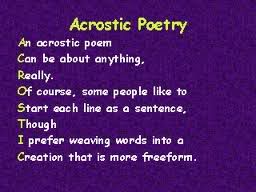
Where would I be without my Thesaurus?  Today it has been most essential as I've been writing an Acrostic poem with the added stipulation that there must be one other word in the line which starts with the same letter as the first letter in that line.  Do you follow?

This poem is now in it's fourth draft.  It began as an exercise with my name but quickly evolved into something else I rather liked so I felt I had to go with it and change the Acrostic letters to match the poem.  The second draft was rather cumbersome, some nice words or phrases but it didn't flow well.  The third draft began to take shape and I was able to expand on the last two lines which really began to come together. The fourth draft, done with the aid of the Thesaurus,  is about there.  I need to leave it to marinate for a short time and then see if it still works.

Using the Thesaurus was much easier than using a dictionary for this and when I either can't find the right word or need another/better option this book comes into its own.  In this case it really helped me to tease out meaning, losing that rather disjointed use of words to something that began to flow.  Anything that aids writing is a useful tool.

If you want to have a go at an Acrostic think of word and then write it vertically down the page like so:

P
L
U
T
O

Here's a first line:

Pluto was a planet once
L


Okay, off you go!

Here is another example, rather good, I think, but not mine unfortunately!


Thursday, 5 April 2012

Notebooks....ignore them at your peril

The first rule of writing (or is it the second?) is to keep a notebook.  I have one.  Do I use it?  Er.....now and then, but not as much as I should.  Hence when trying to recall an unusual moment to write about (I'm working through the chapter on Voice in W.N. Herbert's book Writing Poetry) I knew there was a moment recently but of course I didn't write it down and I couldn't recall it!

There am I telling you all you should do this and do that and what am I doing?  Breaking the rules.  But like everything in life whether you choose to follow my advice is up to you - I obviously don't.

Still, all is not lost.  I was able to recall another unusual incident and wrote about that and actually liked what I wrote! So there.

We have internet problems at the moment but are switching over to Virgin Media on the 13th April (going fibre optic).  I've finally got internet access today so am making the most of it, but if it all goes quiet for a while you'll know why.  To quote those famous lines - I'LL BE BACK.

Meanwhile here is the winning poem from the National Poetry Competition 2011.


Sunday, 11 March 2012

The Ballad of Solar Flares and a Writers' Day

Grape Hyacinth in my garde
Writing ballads isn't really my favourite poetry form but that is what we looked at on Thursday at poetry class. There was all this stressed and unstressed talk again...ahhhh!  I counted syllables from our examples and used that as a guide when we had to write our own.  The subject was the solar storm that was being talked about that day.  We had a news report to use as background information and we were told to use our imaginations and just go for it.  There was a lot of giggling and laughter as we tried rhyming our lines and even more laughter as we read out our scribblings.  These were my two verses:

Tonight I put my PC on
To see who had hotmailed
My Inbox flashed a page which said
The Universe has failed.

The solar storm had hit the earth
And all the radiation
Had knocked out all the satellites
Messing communication.

We've been asked to develop our ballad and take it back the week after next.  I've since written another six verses of this very weird story!

For those of you who want to write a ballad the form is abab, stanzas four lines long with rhymes on the 2nd and fourth lines or the 1st and third lines (or each line can rhyme), stresses are 4 in 1st line, 3 in 2nd, 4 in 3rd and 3 in 4th (or even 3,4,3,4!).  Ballads tell a story like The Rime of the Ancient Mariner (though there is a variation here in the form).  Have a go yourself.

Yesterday I attended the Writers' Day.  Excellent speakers, including Liz Babbs.  She spoke about a writer's profile, using 'platform' to advertise ourselves through blogs, websites, Facebook, Twitter and other online media, as well as giving talks and interviews.  Liz was very enthusiastic and funny.  She gave us much to think about.  The next speaker was from Lion Hudson, publishers of religious books.  He spoke about how Christian writers can go about keeping theology in their writing without being 'preachy', something that can be difficult to handle.  After lunch there were three workshops to choose from, one for beginner writers, one for professional writers and the one I attended which was on Self Publishing.  Here I learned the difference between mainstream publishers, vanity publishers, print-on-demand and self publishing.  There were plenty of hand-outs and tips on how to go about self publishing and the cost involved.  People had many questions; one was about ISBN numbers, did we need them and the cost.  We were told that if we were just printing a booklet to hand to family and friends we didn't need an ISBN number, but if we wanted to sell copies, have them in libraries etc., then an ISBN number would make the book traceable.  The cost would be between £10-£20 for one ISBN number.  I found it a very interesting workshop.

Member authors had books on sale during the day and I bought a poetry book (surprise, surprise!).  Simon Baynes is my favourite ACW poet!

Going to something like a writers' day makes me realise I have much still to do/learn.  I felt awful that I'd not done much new writing this year and had sent out nothing for potential publication.  So bad did I feel that this morning I sent three poems off by email and vowed to spend more time writing new stuff and editing older things.

Tuesday, 28 February 2012

Italian Sonnet and something to try

Much have I travelled in the realms of gold,
  And many goodly state and kingdoms seen: 
                      (Keats - On First Looking Into Chapman's Homer)

Apologies for not checking in sooner, life has been rather busy of late.

I did no writing in Half Term and seem to be finding lots of reasons why I haven't the time to write poetry.  However, last weeks class was a good one.  There were only five of us which might actually work better.  We had one poem from a student to workshop and then looked at Sonnets again.  This time we studied the Italian, or Petrarchan sonnet and then work-shopped two, a Keats and one by Seamus Heaney  to see what they did with the form.  Petrarchan sonnets have 14 lines with a rhyming pattern of abba,abba,cdecde (or the last 6 lines could be cdedcc or cdeced or cdcdcd).  The poets had different ways of writing and the rhyming was....well, you had to look for it at times with lots of nearish rhymes, some barely in Heaney's case.

Our tutor then set us an exercise to write a sonnet .  We each had to write two nouns (naming words) on a piece of paper and pass it to our right.  Then we had to write a question against one of the words which we would use to sum up in the last three lines.  Then using our words we had to write a sonnet with 7 lines, four and then a turn in the last three lines.  We had about 15 minutes to write and it was a struggle for us!  Our tutor said it was a difficult exercise but we didn't have to rhyme or have set length of lines.  We all managed to produce something though I don't think I really got writing until the last five minutes!  My words were mixing desk and table and this is what I wrote:

Here the sounds are made,
mixed at this desk
brought together, blended
in a machine, a box of songs.

But how real are the sounds?
Does this table talk?
What colours the melody?

My tutor thought it was great!  Looking at the piece now I'd edit the second line and say 'at this mixing desk' to keep true to the words I received, but I was editing to the very last minute at the time!

Try it yourself.  Here are your two words:    book, umbrella.  Add your question to one of the words and away your go!

Thursday, 5 January 2012

Looking back - looking forward

My writing 'stuff', files and reference books mixed up with other books - a tidy needed, I think!
I've been looking back over my writing year, seeing what I achieved, any progress made and where I am going this year.

Last year I sort of set myself a target of sending out at least two items a month for either possible publication or competition entries.  It is always a good idea to set low targets because if you aim too high you are more likely to fail and then feel despondent.

In January I submitted to four different places, two competitions, one with two poems, one to another and two hopeful publications.  One, Poetry on the Move, halted its publication and has never yet got back to publishing and I wonder if it will so those poems are still 'hanging there'. (Just checked them out and they seem to have disappeared!)

February came and I submitted three poems to two different competitions - no luck there either.

Not sure what happened in March but I have a feeling I wasn't very well and nothing got sent out but I kept on blogging!  In April I submitted a short story to a competition - no luck.

In May I went mad and entered five pieces, one was to a webzine and I got close to publication but they said the last two lines of my poem were weak!  One was a postcard comp with the Arvon Foundation (no luck), another to Poetry London (no luck) and two to Areopagus, both published and one was awarded first prize in their summer competition.

June and July I entered three competitions in each month (one was a mini saga) and a couple had three poems entered (no luck).

August I took off from writing much - I needed a break!

In September I entered a short Story to Best magazine (no joy there).  In October I had two poems published in the Workbook of OU Poets and they are out for voting on by members to see if I get published in their Anthology later in this year.

In November I entered three poems into a competition and three to Areopagus and Areopagus printed all three (where would I be without them?!)

Last month (December) I entered one poem to Holland Park Press - too early for any result on that.

Last year I decided to really give writing a go after reading and working through a particular book on writing (the name escapes me but it was mentioned here at the beginning of last year).  Although I didn't follow the book completely and detested the free writing every day, I did get something from it as some of the free writing tuned into poems and potential short stories.  So I booked up some courses for later in the year and I sent for some free samples of magazines on writing and subscribed to some new publications.  I read a lot more poetry and began writing more. I went to a poetry reading and an open mic session.  So although I haven't achieved a great deal in publication I do feel I have  moved on.  My writing had become a bit stuck earlier last year, but now I feel I've moved forward slightly.

It is easy to get depressed as a writer, knock-back after knock-back but I take comfort and encouragement from the feedback I have had from the courses I've done this year, both from fellow writers and the tutors.  It means I am not completely wasting my time, that others do like what I write and that I should keep going (in fact I can't imagine life without writing something!).  I am always blown away when someone says something good about my writing because as a writer you always wonder if you are fooling yourself!

So what about 2012?  Well, I am still doing my course at Morley College in London and I will keep writing and reading and submitting to publications/competitions.  I will try and stick to the same targets as last year (I don't think there is much chance of me doing more yet!).  More than that I cannot say at present.  I did hear about a poetry course run by the Arvon Foundation (the elite for writing courses) but I heard too late because already it's fully booked. I must try to find out when there will be another course.  So many people have praised their courses (they do courses in short story writing etc. as well) and my class tutor has done a course with them.

Whatever this year brings I will be here to write about it - the good, the bad, the ugly!  I hope you will be here too and that you will find something worth reading, an exercise inspiring or the whole thing funny!  Whatever your thoughts, do comment now and then, it makes all the difference.

Happy writing!

Tuesday, 13 December 2011

What will you be doing next year?

If you didn't sign up to any writing courses in the autumn, now is a good time to do it as part of your New Years' resolution!  There are bound to be courses in your area or online, or maybe if you know others who write (friends/acquaintances) you could form your own group and meet at someone's house or a pub or coffee bar.  The  you can set a programme of exercises, read books of poets/authors, attend some 'open mic' sessions in your area (do some research!).  The idea is to be with others who write, whether you are a beginner or a little further on with your writing.  We can all learn something by being with others and share our passion and our work.  Small groups often go on to produce booklets of members work which can be sold locally.  The sky is the limit!


What will you be doing next year?  If you have any other ideas for writing why not share them here.